What makes football World Cups exciting?
Originally published on Jan 21, 2024 on Medium (original article).
Watching “Captains of the World” on Netflix recently made me think: What makes football World Cups exciting? And how did 2022 compare to the ones that came before?
“Just watch the highlights and make up your mind” — I hear you say. But these can be very subjective — for instance, I’m biased towards certain WC editions simply as a R9/Ronaldinho/Messi fan. So I dusted off the old Excel and dove into the data instead, which is (ever so slightly but not nearly as much as people think) more objective. And fun.
Here’s what I found.
9 World Cups considered (1990–2022)
First, the small matter of choosing the parameters. Note:
I tried to pick parameters that are entertaining for the average/neutral fan (that the average fan is rarely neutral is another discussion altogether).
No advanced stats (no xG, xT, xGchain.. keeping it simple).
Goals
Like it or not, goals are a big draw for the average fan (and me). Here, there are more specific ground rules I considered:
More goals is better, up to a point (e.g. 2–0 > 0–0, but 6–0 is about the same as a 4–0)
Close games with goals are better (3–2 > 4–1, for the same # total goals. Definition: Goal difference of 0/1)
Late goals (70th minute or later) really amp up the excitement in close games (but not for unequal games — e.g. a late goal taking a 3–0 to a 4–0 isn’t exciting, but a late winner taking a 1–1 score to a 2–1, is)
So let’s look at some data..
Goal per game & Close games
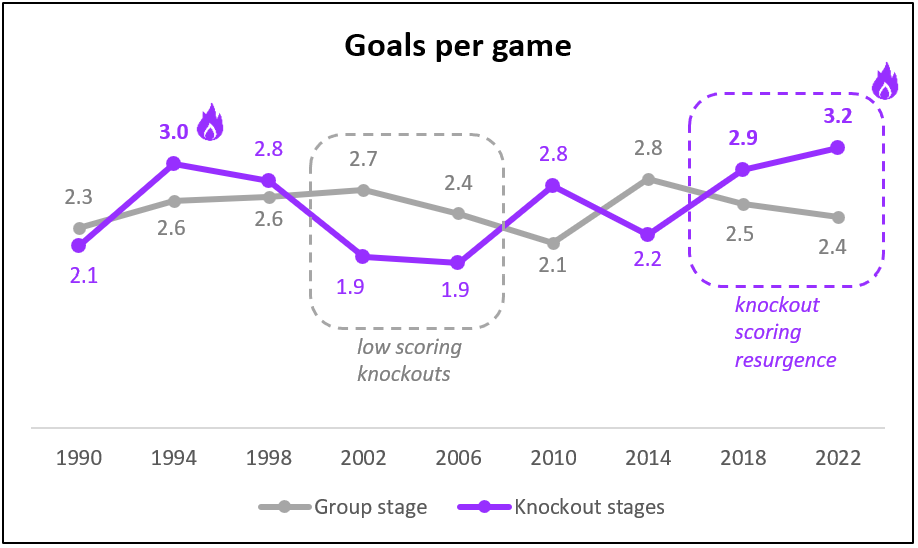
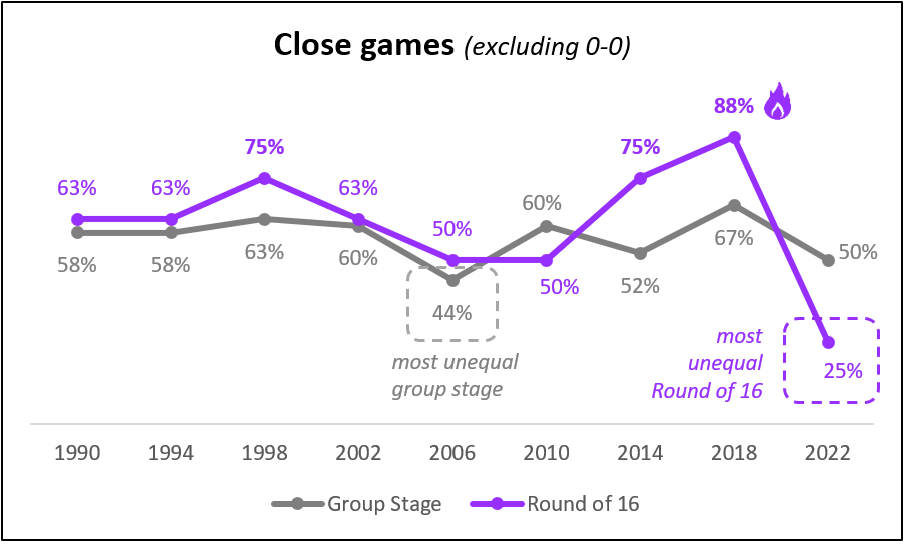
Interestingly,
2018 & 2022 have seen a resurgence in knockout scoring (along the lines of the OG — 1994), after huge slumps in 2002 & 2006.
Examples of how this stat played out: In 2006: Portugal made it to the semi-finals, scoring just 1 goal after the group stage. Switzerland v Ukraine (0–0) was called by one journalist the “dullest game in WC history”.2018 saw the most closely contested matches, followed by 1998
This made me curious: Which teams’ matches have more goals? Do they win these?
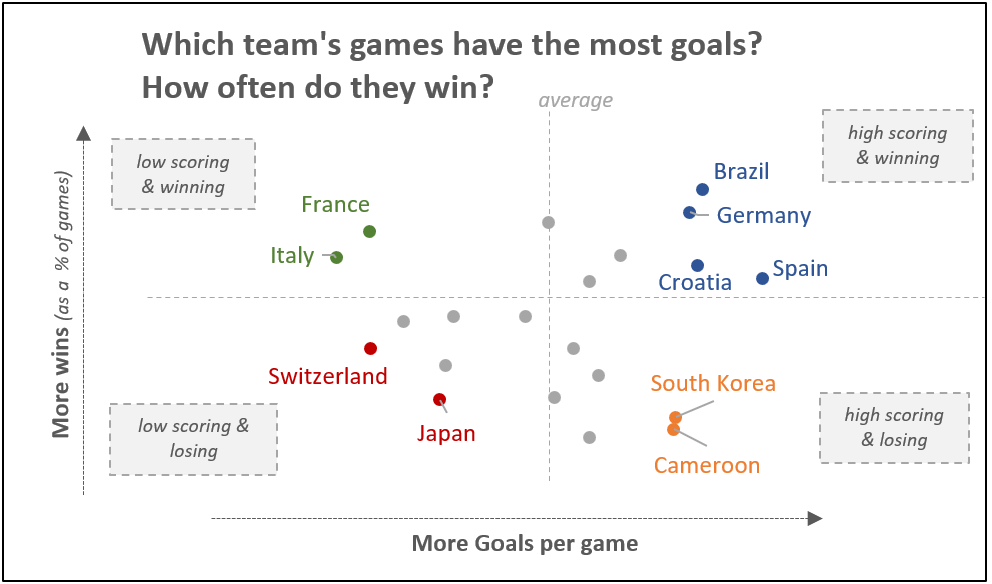
If you’re a neutral fan trying to book tickets for the next WC, this graph may interest you (but check out the next one. Just more goals isn’t fun enough)
Late Goals
There are ~24 late goals in close matches in each WC on average (with 2006 having the lowest at 14 — I’m seeing a trend here). The overall graph isn’t too interesting.
But there is an interesting follow-up question here:
Which teams play more matches with late goals? And which teams benefit more from late goals?
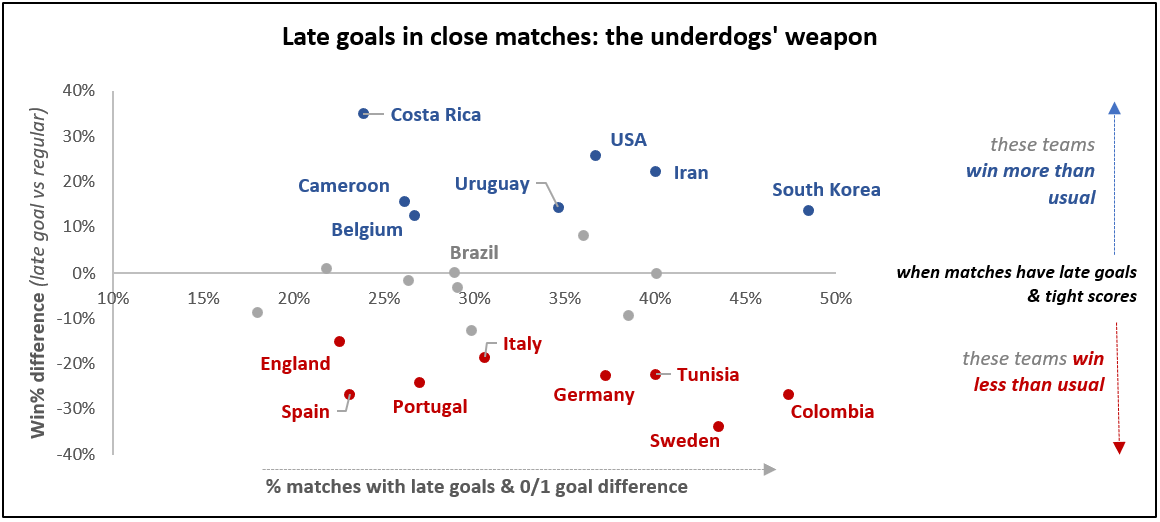
Now you can book those tickets. South Korea matches seem to have everything — don’t miss out on those
Late goals are a (small) equalizing force in World Cups — underdog teams improve their winning odds when there are late goals. (note: slight improvement in odds is not to be confused with equality of results — the big teams still win much more often, with or without late goals).
Extra Time/Penalty Shootouts
Next obvious item on the excitement checklist — Extra Time & Penalty shootouts. Can be unfair/cruel, but definitely exciting for the average fan.
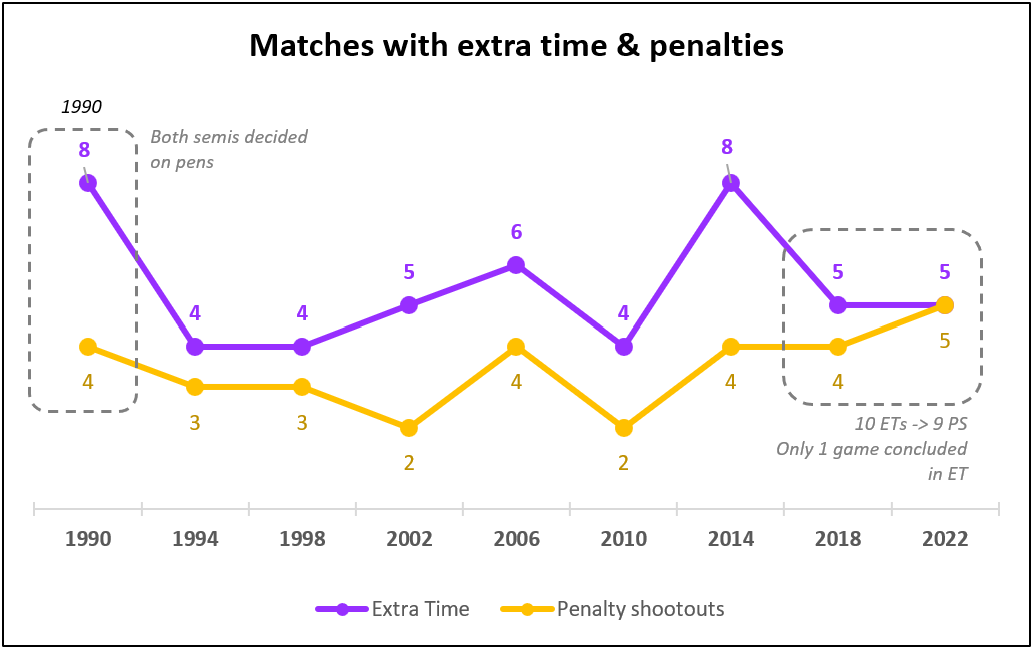
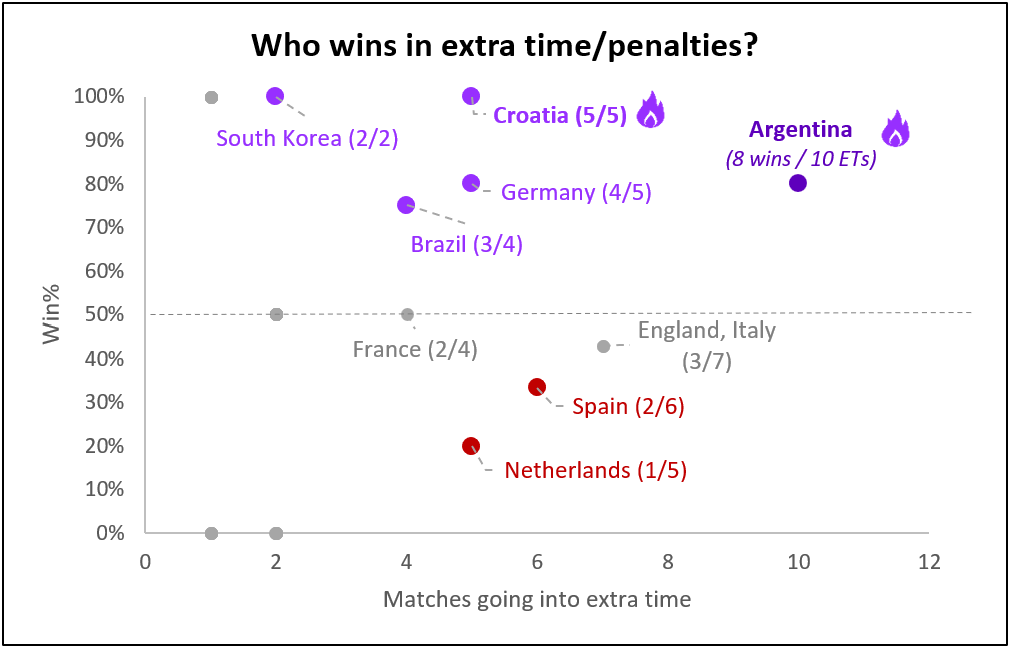
Netherlands fans: If it didn’t happen in regulation time, it’s probably not your day. Nothing good happens after the 90th minute.
What’s interesting:
Over the last 2 WCs, 10 matches went into extra time. Only 1 concluded there — 9 went to penalties (it was 6/12 for the 2 WCs before this). Are teams getting too good at battening down the hatches in ET and preparing for the pens?
Argentina & Croatia seem to have figured out their ET+PS strategy down to a tee (or are just really good at handling the pressure, somehow)
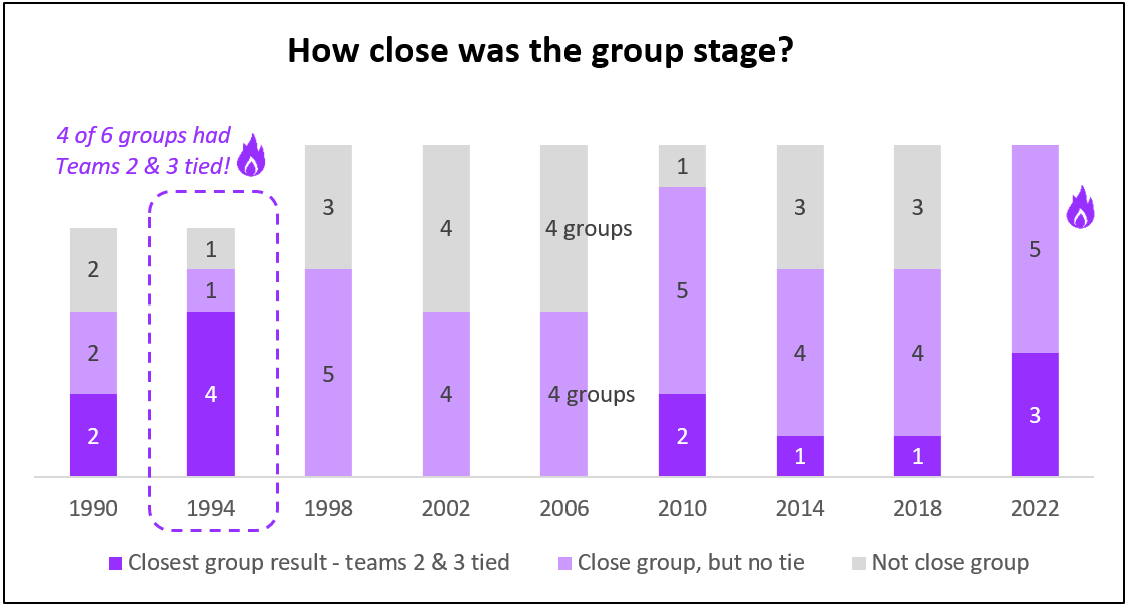
Close Group stage qualification
Last matchday qualification drama deserves its own chapter in this book. And 2 world cups stand out here: 1994 & 2022.
Upsets
Upsets make World Cup stories memorable.
A 38-year old Roger Milla imposing his will on WC 1990 without starting a single game, Papa Bouba Diop’s winner against France in 2002 inspiring the next generation of Senegalese footballers (including the current captain Koulibaly, who left France to play for Senegal), South Korea’s dream run in 2002.. and many more.
Q: But how do you compare upsets against each other?
A: The Elo ratings system. Yes, the same one that’s used in Chess.
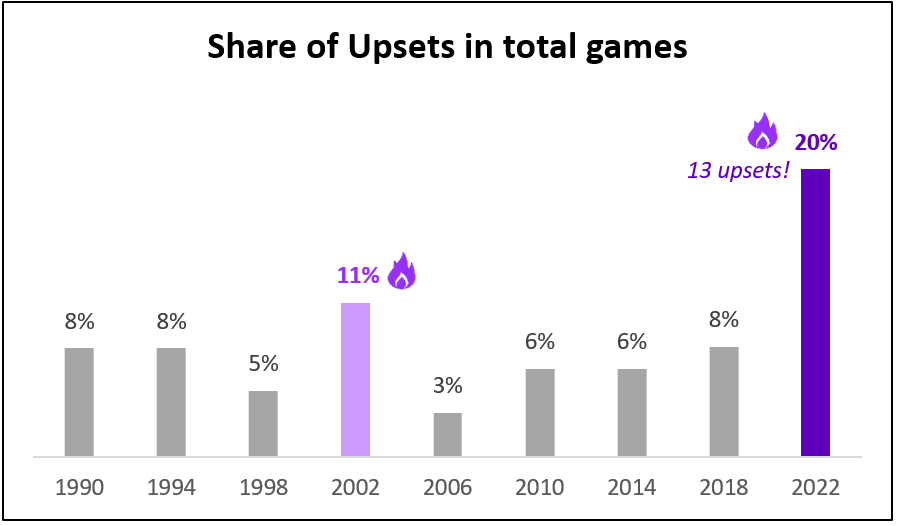
Among the many reasons it’s so good, is that it can be easily converted to a win probability for any match-up. So what does this tell us about the upsets (teams winning matches with a less than 30% chance) in WCs?
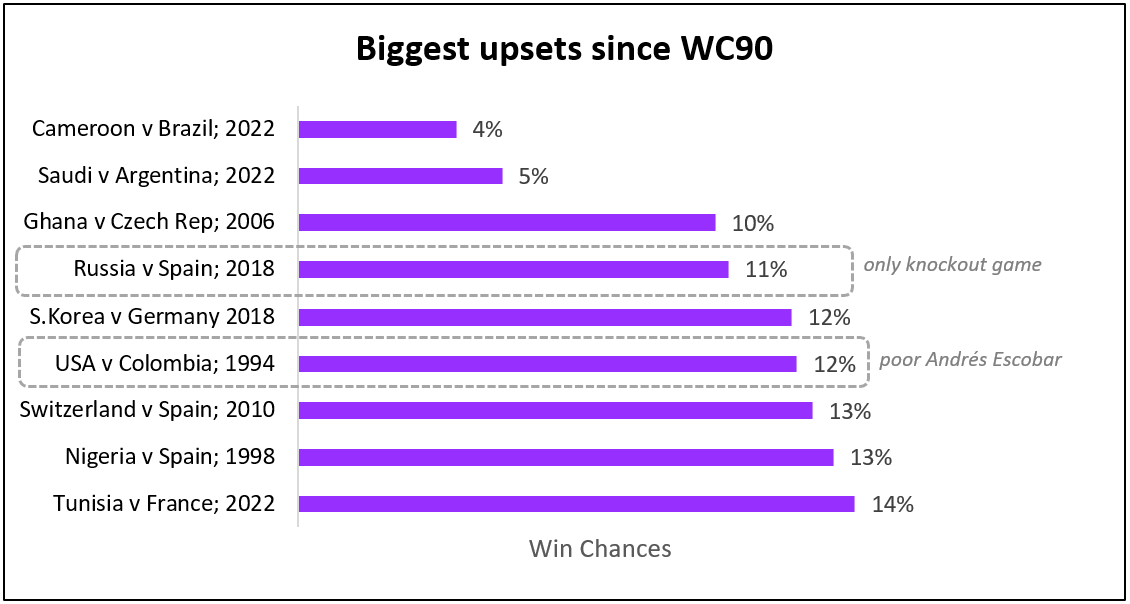
Read more about the Andrés Escobar episode
2022 was just something else. 13 upsets, including the 2 most unlikely wins of the last 9 WCs.
Fouls
There are fouls (boring, disruptive & regular), and there are fouls — the elite tier — headbutts & studs-on-chest kicks in WC finals, and savage chops that have been described thus:
“The general intention seemed to be not so much to break Caniggia’s legs, as actually to separate them from the rest of his body” (reference).
Unfortunately, I didn’t have a way to segregate the elite from the banal. So for this analysis, fouls are a negative parameter. To take into account the constantly changing refereeing standards (many routine yellows today weren’t even acknowledged 30 years ago), I used only Red cards to get a (somewhat better) comparison over time.
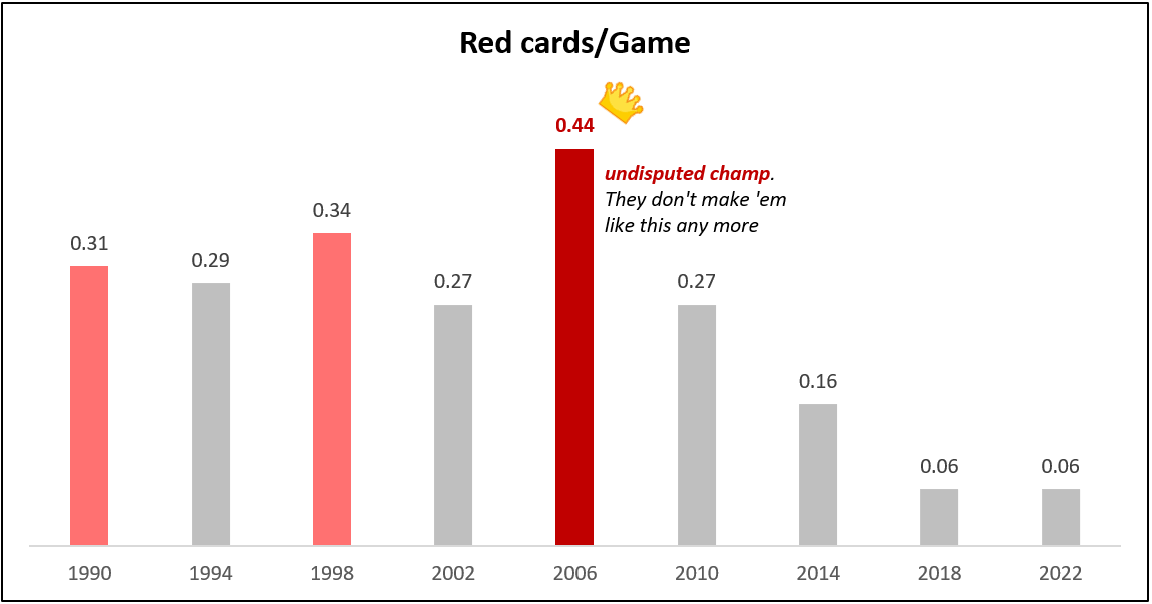
2006 is in a different league (would be #1 even after excluding the Battle of Nuremberg)
Scoring & Results
Scoring
For each parameter discussed above, I assigned points to each match. Additional points were given for the same result happening at a knockout game, or if it involved a Top-10 team in the world at the time (a proxy for audience interest, and Top 10 teams are more likely to have the most famous players).
I then added up the points at a match, stage & WC level. These are the final results from this exercise.
Best Games
These are the most entertaining games of the last 9 WCs.
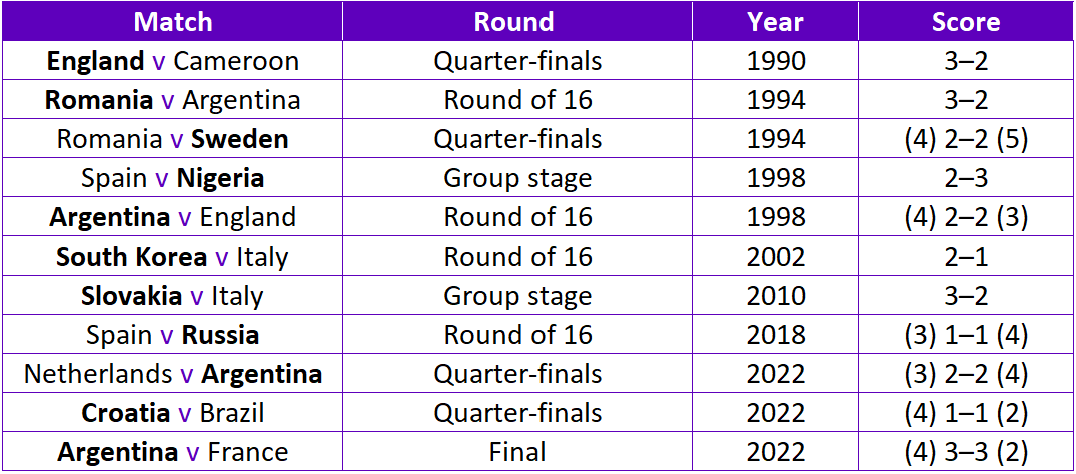
Another tip for neutral fans: book R16 or QF tickets. Don’t pay extra for the semis
Matches from 7 of 9 editions represented in the list of the best. Also, in 2022 we definitely watched the most entertaining WC final of the last 9 editions (maybe ever?).
Best World Cup
<drum roll..>
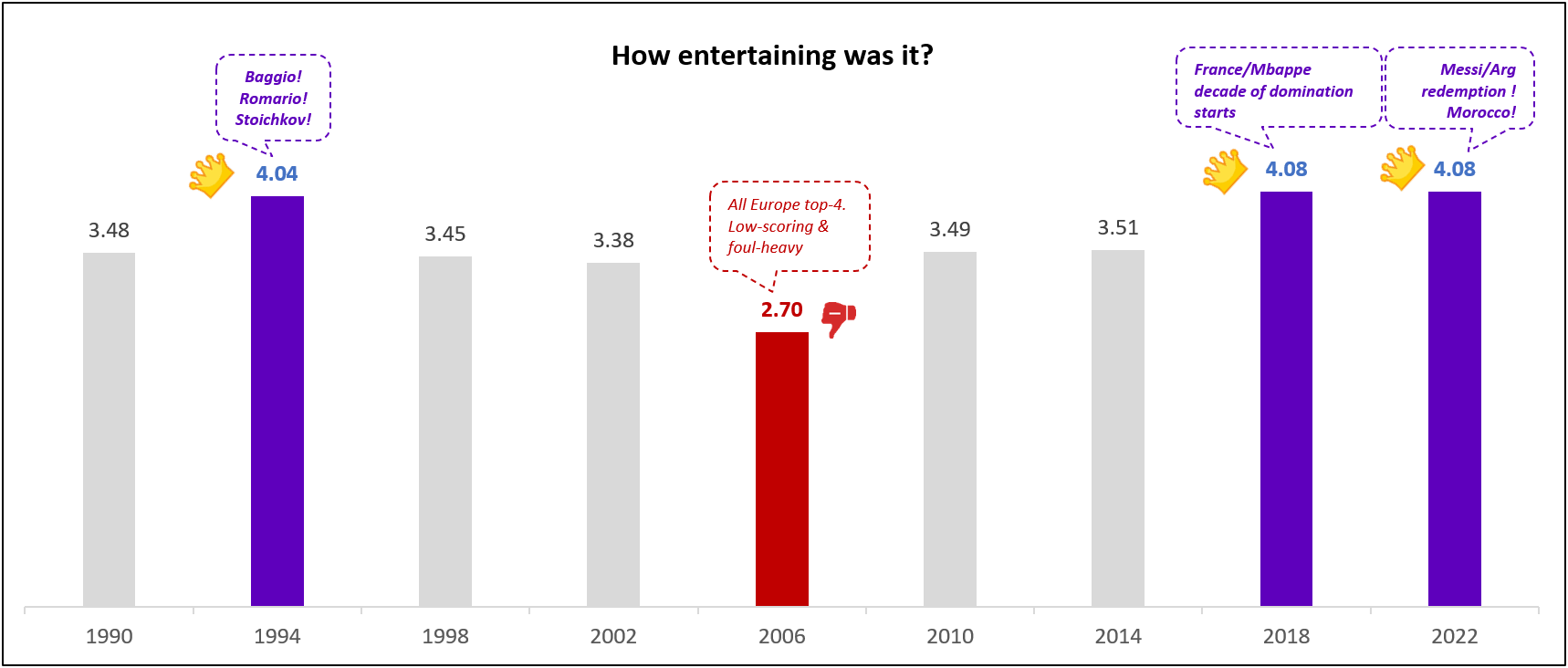
Petition to get a Netflix show about the 1994 WC
The 3 best World Cups are: 1994, 2018 & 2022.
We also have a clear loser: 2006 (not a surprise, if you’ve been following the graphs above this one. Lowest goals, close matches, late goals & highest on fouls).
What I didn’t consider
Some things that contribute to the hype around different WCs that I didn’t consider, but wish I had some way to quantify/get data for:
Individual Narratives (WC-less superstars seeking the final milestone, player/coach rivalries)
Team Narratives (Golden generations of Spain, England, Belgium etc coming in with heightened expectations, and getting varying results; pressure on top teams from trophy droughts; rivalries)
Where the WC means much more than just sport for some countries because of a less-than-ideal domestic situation
Sources
Match stats: Fbref